

We use cookies to improve your experience and deliver personalized content.
By using our website, you agree to our
Cookie Policy.
Ten years ago, you can spot a scam email even from ten miles away. The spelling was off, the tone was strange, the phrasing seemed awkward, and the request made little sense. Today, an attacker can generate a polished, personalized message in seconds, in any language, written even in your CEO’s style.
That shift is at the heart of the AI-powered cyber threat problem. During the first quarter of 2026 (January–March), Microsoft Threat Intelligence identified approximately 8.3 billion email-based phishing threats, highlighting the sheer scale at which these attacks continue to target organizations. But phishing is only one part of the picture. From AI-generated social engineering and deepfakes to automated credential attacks and other emerging threats, AI is giving cyber criminals new ways to make attacks more convincing, scalable, and difficult to detect.
For businesses, understanding how these threats are evolving is the first step toward protecting their people, data, applications, and cloud environments. In this article, we break down what these threats are, how they work, what they mean for your business, and how to build a defense that holds up—while exploring what to look for in a cybersecurity partner in thePhilippines to help you stay ahead of an evolving threat landscape.
AI-powered cyber threats are attacks in which criminals use artificial intelligence to make malicious activity faster, more convincing, or easier to scale. This includes phishing, impersonation, password attacks, malware development, and target research.

Most of these arenot brand-new attacks. They are familiar attacks with better tools behind them,which means more volume, better quality, and less time to react.
Three things make AIa genuine shift rather than a buzzword.
At the same time, businesses are adding cloud platforms, SaaS tools, remote access, and AI applications. Each addition is another place an attacker can try to get in.
How does AI make phishing more dangerous? It removes the obvious flaws. Attackers can produce fluent, context-aware emails and chats that mimic real colleagues, suppliers, or IT staff, making them much harder for employees to challenge.
Typical scenarios include:
Employees can no longer rely on spotting typos. They need a habit of verifying requests, not judging writing quality.
How are deepfakes used in cyberattacks? Attackers clone a person's voice or face to make fraudulent requests sound legitimate, often as part of a phone call, voice note, or video meeting.
The practical defense is procedural. Any payment, credential change, or sensitive data request should be confirmed through a separate, trusted channel, no matter how real the voice or video seems.
Why do attackers go after credentials? Because a valid login is the quietest way in. It lets an intruder look like a legitimate user and avoid many alerts.
AI-assisted tooling can speed up credential stuffing, password guessing, and the targeting of high-privilege accounts. Strong identity controls are therefore one of the most valuable investments a business can make: multi-factor authentication, least-privilege access, and tight control of administrator accounts.
Automation lets attackers probe many systems, try many variations, and adjust based on what works. The threat is less about any single clever attack and more about relentless volume. Defenders need monitoring and response that can keep pace.
AI can help attackers tweak malicious code, research weaknesses, and produce variations that slip past basic defenses. The takeaway for businesses is simple: the window between a vulnerability being discovered and exploited is shrinking, so patching and vulnerability management cannot be left to chance.
Not every AI riskcomes from a criminal. Some come from well-meaning teams adopting AI without guardrails.
A complete securitystrategy covers both sides: defending against AI-enabled attackers, andgoverning how your own people and systems use AI.
The damage rarelystops at IT.
For leadership, this is a business continuity issue as much as a technical one.
By layering defenses so that no single failure leads to a breach. A workable baseline looks like this:
Security tools work best when they share information. A phishing email, a suspicious login, and an unusual data transfer might each look minor alone, but together they tell a story. That is why effective cybersecurity blends people, processes, and integrated technology across endpoint, identity, network, cloud, and monitoring.
Many organizationsdo not have the staff to run round-the-clock security, and hiring a full in-house team is costly. Two kinds of partners can help.
For organizations seeking managed cybersecurity services in the Philippines, outsourcing monitoring and response provides access to specialist expertise without building a full security operation. Look for 24/7 coverage, proven detection and response capability, vulnerability management, clear reporting, and the ability to scale as you grow.
A cybersecurity solution integrator inthe Philippines helps you assess your environment, choose the right technologies, and connect them into one coherent architecture, so you are not left managing a pile of disconnected products. This is especially useful for organizations with hybrid or multi-cloud environments and mixed legacy systems.
AI workloads live in the cloud, draw on business data, and connect through SaaS and APIs. Protecting them means thinking end to end:
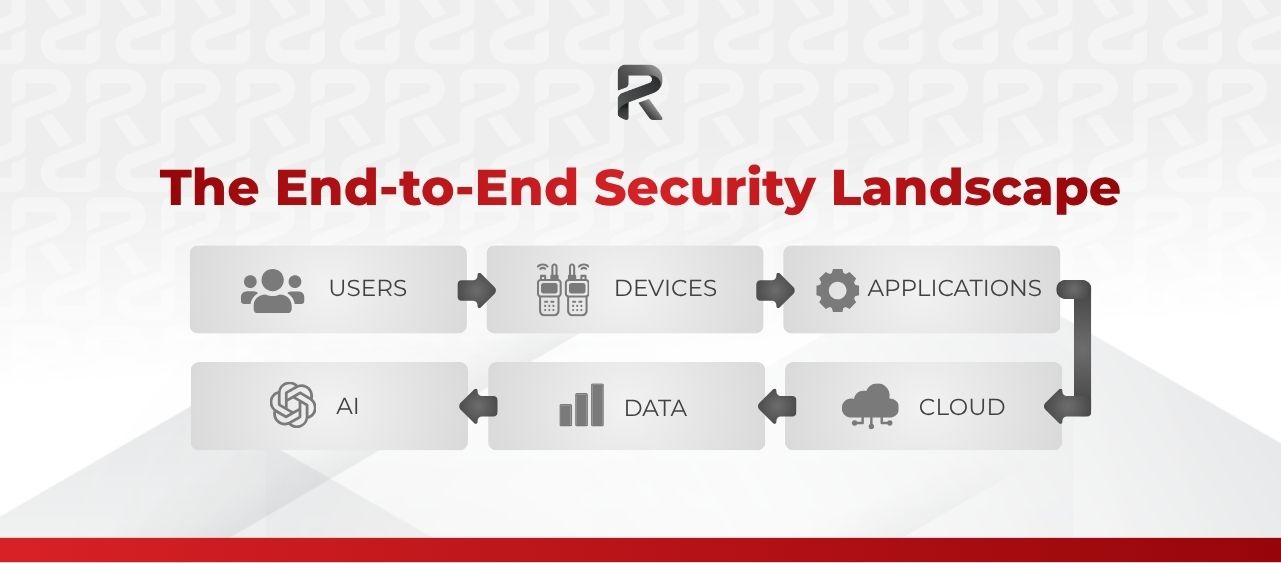
Organizations evaluating AI security solutions in the Philippines should look for coverage of both sides: protection against AI-enabled attacks, and controls over which AI tools are approved, what data they can access, and how AI applications are secured.
Radenta supports organizations with Radenta cybersecurity solutions built around their environment, risk profile, and business goals, rather than a one-size-fits-all product. As a technology partner and solution integrator, Radenta helps businesses bring security capabilities together across four areas:
Whether you are just starting to formalize your security posture or modernizing an established program, Radenta can help you find the gaps, prioritize what matters, and build a defense that adapts as threats evolve.
It is an attack that uses AI to automate or improve malicious activity, such as writing convincing phishing messages, cloning voices, or speeding up password attacks. The goal is usually the same as traditional cybercrime, but the execution is faster and more polished.
Mostly they are existing threats made more effective. Phishing, fraud, and credential theft are long-standing tactics. AI raises their speed, scale, and believability.
Less reliably than before. Because grammar and tone are no longer tell tale signs, businesses should combine training with technical controls and mandatory verification for sensitive requests.
A deepfake scam uses a cloned voice or synthetic video of a trusted person to trick someone into sending money or sharing information. Confirming the request through a separate channel is the most effective safeguard.
Layered security:strong identity controls, monitoring, cloud protection, timely patching,employee awareness, and a tested response plan.
Typically continuous monitoring, threat detection, incident response, and reporting, delivered by a specialist provider so you do not need to build every capability in-house.
Cloud platforms hold critical data and applications, and a single misconfiguration or compromised account can expose them. Strong cloud security keeps access controlled and activity visible.
Begin with asecurity assessment to identify gaps, then prioritize identity protection,monitoring, training, and incident response, ideally with a local partner whocan turn findings into a practical roadmap.
AI will keep reshaping both what businesses can do and what attackers can attempt. The organizations that stay resilient will be those that treat security as an ongoing, integrated effort rather than a one-time purchase.
Ready to review your cybersecurityposture? ContactRadenta Technologies Inc. today for cybersecurity assessment or reach us at info@radenta.com or (02) 8535 7801.
Radenta Technologies Inc. provides managed IT services and cybersecurity solutions designed to help Philippine businesses move from reactive support to proactive protection.
Last updated: October 2026
